
Home gym equipment breaks two rules at once. It is heavier per piece than almost anything else in a residence, and it concentrates that weight into shapes that offer nowhere good to grip. A loaded dumbbell rack, a power cage, a treadmill with a motor housing, and a cable machine with a weight stack all exceed what two people should be carrying down a staircase, and the damage when something goes wrong lands on the floor, the doorframe, or someone’s back.
Heavy pieces of every kind are moved across Santa Clarita, CA by furniture moving crews who handle heavy pieces, from a few plates and a bench in a Saugus garage to full rack and platform builds in Valencia and Stevenson Ranch. Crews complete the American Moving and Storage Association Certified Packer Loaders Program, which covers load sequencing and heavy item technique, and that matters more here than in almost any other category in the house.
Start With Weight, Not With Size
Equipment should be inventoried by weight before anything else is decided. A bumper plate set, a dumbbell collection running from five to fifty pounds, and a weight stack each weigh more than the furniture around them, and the total routinely runs into four figures for a modest garage setup. That number drives crew size, truck selection and, on interstate jobs through our National Van Lines network, the price itself.
Plates and dumbbells travel in small boxes rather than large ones, with each box kept to a weight a person can lift properly. Filling a large box with plates produces something nobody can carry safely, and that will fail at the seams. We raise this during the in-home estimate, because a garage gym is one of the most commonly underreported items when a household calls for a quote and then wonders why the final scope looks different.
Disassemble Racks, Machines and Treadmills Properly
Power racks and cable machines come apart into manageable sections, and they should. Moving a rack assembled means carrying an awkward steel frame through doorways it barely cleared on the way in, usually while it catches on the jamb. Bolts and hardware go into a labeled bag taped to the largest section of each unit, so reassembly does not start with a hardware store trip.
Treadmills need particular care. Most fold at the deck, and the folding mechanism should be locked before the unit moves rather than relied on mid-carry. The motor housing is the heaviest point, and the console is the most fragile, so the unit travels padded, upright where the manufacturer allows it, and strapped so the deck cannot drop open in transit. Elliptical machines and bikes follow the same logic, with pedals and arms removed where they detach. Our crews apply moving pads and shrink wrap to any surface that will contact a wall or another item on the truck.
Protect Floors, Walls, and the Equipment Itself
Gym equipment causes most of its damage on the way out of the house, not on the road. Steel edges meet doorframes, plates meet tile, and a dropped dumbbell on a hardwood floor is a repair bill in a home that may already be in escrow. We apply carpet shield on floors and padding on doorframes and high-traffic areas at both the origin and the destination on every job.
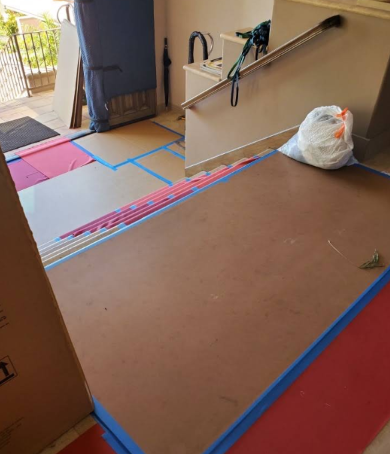
A few decisions prevent the common failures:
- Clear the carry path completely before anything heavy moves
- Strip plates off bars and racks rather than moving them loaded
- Pad and wrap any painted or powder-coated surface before it leaves the room
- Keep rubber flooring tiles stacked flat rather than rolled
- Move the heaviest items first, while the crew is fresh and the path is clear
Experience rather than theory is behind the way crews handle large or fragile items safely, which is part of why reviewers mention them by name. Barry, Oscar, Rene, and others have been singled out by customers for exactly this kind of careful handling.
Not sure how heavy your garage gym really is? Give us a call at 661-254-7823, and we’ll inventory it before quoting, then size the crew and equipment to the actual load.
Decide What Is Worth Moving and What Is Not
Not every piece of equipment earns its place on the truck. Older treadmills and ellipticals with worn belts or motors often cost more to move on a long-distance job than they would cost to replace at the destination, particularly once their weight is priced. The same applies to rubber flooring, which is heavy, and to a bench that has already seen better days.
Plates, bars, racks, and dumbbells are a different calculation. They do not wear out; they hold value, and replacing a full set at the other end costs far more than transporting it. We work through this during the walkthrough and give you a written price with no hidden fees, so the decision gets made against a real number rather than a guess. Customers frequently reduce the load here more than anywhere else in the house.
Use Storage If the New Space Is Not Ready
Gym space is usually the last area finished in a new home. A garage needs clearing, a bonus room needs flooring, or a build-out runs past schedule, and equipment that arrives early ends up stacked in a hallway where it becomes a hazard for weeks. Planning for that gap in advance is simpler than reacting to it, and it helps to know what storage options suit a move in progress.
We operate our own storage vaults rather than handing customers to another vendor, with more than 40,000 square feet, private sanitized vaults, internal surveillance around the clock, and no minimum duration. Equipment goes into a vault after pickup and comes out when the space is ready, handled by the same crews at both ends. When we handle the move, the first two months are included at no charge. Casey and Kelly Kirkman have run the company this way since 2006, with the equipment, the storage, and the accountability all staying in-house.
Ready to plan the heavy part of your move? Call our Santa Clarita team at 661-254-7823 or stop by 25701 Springbrook Ave, Santa Clarita, CA 91350, and we’ll book a free in-home estimate and inventory the gym properly before quoting. We’re open Monday through Saturday, 8:00 AM to 5:00 PM.
Related Topics: