
Pets pick up on everything. They may not know what a move means, but they notice when boxes take over their favorite spots, when routines shift, and when the people they rely on are running on stress and little sleep. That energy comes through clearly, even to animals. Choosing a hands-on moving company staffed with skilled movers helps cut down on the chaos, but preparing your pet in advance makes the whole experience far less stressful for both of you.
This guide covers what works at each stage of a move with pets, whether you are relocating within the Santa Clarita Valley or heading somewhere outside of California.
Start with Your Pet Before You Start Packing
The packing stage is often harder on pets than moving day itself. Familiar smells and furniture arrangements start changing weeks ahead of the move, and for some animals, that builds into real anxiety over time.
One practical approach: leave your pet’s immediate space intact as long as possible. Pack other rooms first before getting to the area they use most. Their bed, their toys, and their feeding spot should stay in place until close to the last day. It preserves a sense of consistency during a period when a great deal is shifting around them.
If your pet tends toward anxiety, talk to your vet before the move. There are options, from behavioral strategies to short-term medication, that can help. Do this early. Waiting until the week before the move does not leave enough time to see how your pet responds to anything new.
Moving Day Is the Hardest Part for Animals
Moving day is loud, high-traffic, and full of unfamiliar people carrying things in and out of the house for hours at a time. For a dog that takes time to warm up to strangers, or a cat that disappears under the bed when the doorbell rings, it is a genuinely difficult day regardless of how prepared everything else is.
The most effective approach for most pets is to remove them from the active moving space entirely. This means a secured room with food, water, and their bed while the crew works, or better yet, having someone take them to a friend’s home or a familiar outdoor space for the day.
Our crew works efficiently and professionally, but a moving day is still an open-door environment for hours on end. Animals that are loose during loading can get anxious, get underfoot, or slip out through a door that is constantly in use. A little separation makes the day safer and calmer for everyone in the house.
Dogs and Cats Handle Moves Differently
Dogs usually do better when they can stay with their owner or a familiar person, away from the active move space. A long walk or an off-site activity burns off the nervous energy that otherwise turns into barking or restlessness. If you have a dog that is particularly people-oriented, boarding for the day is often the cleanest solution.
Cats are territorial in a way that makes transitions harder. They are more likely to hide, refuse food, or attempt to return to familiar territory if given the chance. Keep your cat in a single secured room on moving day with a litter box, food, water, and something that carries a familiar smell. Transport them in their carrier once the truck is loaded and the house is nearly cleared. Releasing them into a fully empty house all at once gives them a lot of unfamiliar territory to process in one moment.
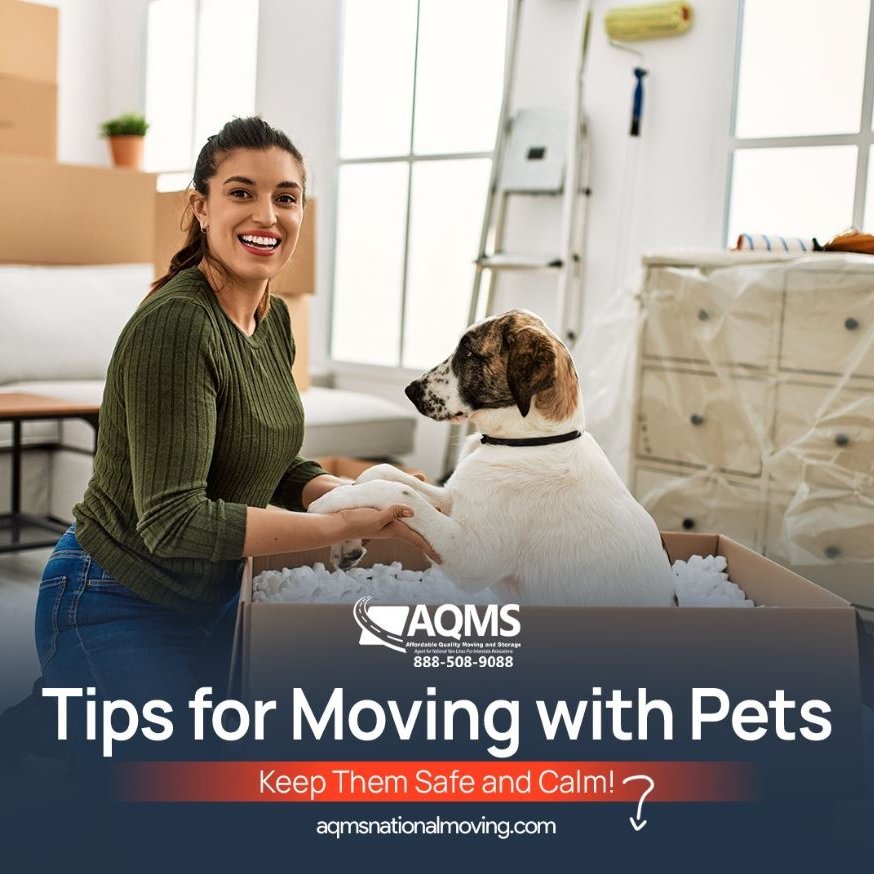
Small animals, birds, and reptiles have their own set of considerations, primarily around temperature and stress during transport. Keep carriers and tanks out of direct sun and away from temperature extremes, and get them set up in a quiet space at the new home as soon as possible after arrival.
Setting Up Your Pet at the New Home
How you introduce your pet to a new space matters as much as the move itself. Letting a dog loose in an empty house the moment you arrive gives them more unfamiliar territory than most animals handle well in one stretch. A better approach is to start with one room, let them explore and settle there, then expand their access gradually.
For cats, keeping them in a single room for the first few days gives them a home base to orient from. Once they seem settled and comfortable there, open up the rest of the space a little at a time. Letting a cat roam freely on day one is a reliable path to a cat that hides behind the washer for a week.
Re-establish routines as quickly as possible. Feed at the same times, walk at the same times, and keep your behavior around them consistent. Routine is what signals to an animal that the situation has stabilized.
Long-Distance Moves with Pets: What Changes
If your move is taking you out of Santa Clarita and across state lines, Alongside your pet’s travel arrangements, Santa Clarita interstate movers can coordinate the household shipment leaving California. A few additional considerations are worth knowing about ahead of time.
Many states require a Certificate of Veterinary Inspection, sometimes called a health certificate, for animals crossing state lines. Your vet issues this document, and it typically carries a validity window of seven to ten days, so the timing of your vet appointment matters. Check the specific requirements for your destination state before scheduling anything.
Pets generally cannot ride in the moving truck. If you are flying to your destination, you will need to arrange pet transport separately, either in the cabin for small animals depending on airline policy, or as cargo. Research this well ahead of booking because availability is limited and restrictions vary significantly by airline and by season.
For long-distance moves from Santa Clarita, we handle the logistics of getting your belongings where they need to go. Your pet’s travel plan runs on a parallel track, and sorting both at the same time prevents gaps in either.
A Few Things Worth Having Ready Before the Move
Having the right items on hand makes the pet side of a move go more smoothly. Pack a dedicated bag for your pet that stays with you, not on the truck. Include food for the travel period, their regular water bowl, a familiar blanket or toy, any medications, and their vet records and vaccination documentation. For long-distance moves, that documentation may be needed at state lines or at your destination.
Our crew is trained through the American Moving and Storage Association’s Certified Packer Loaders Program, which means the people handling your belongings know what they are doing and work in a way that keeps your move day orderly. A less chaotic environment on moving day is genuinely easier on pets, even if they are in a secured room for most of it. We have been helping Santa Clarita families relocate since 1996, and we understand that a home includes everyone in it.
Related Topics: